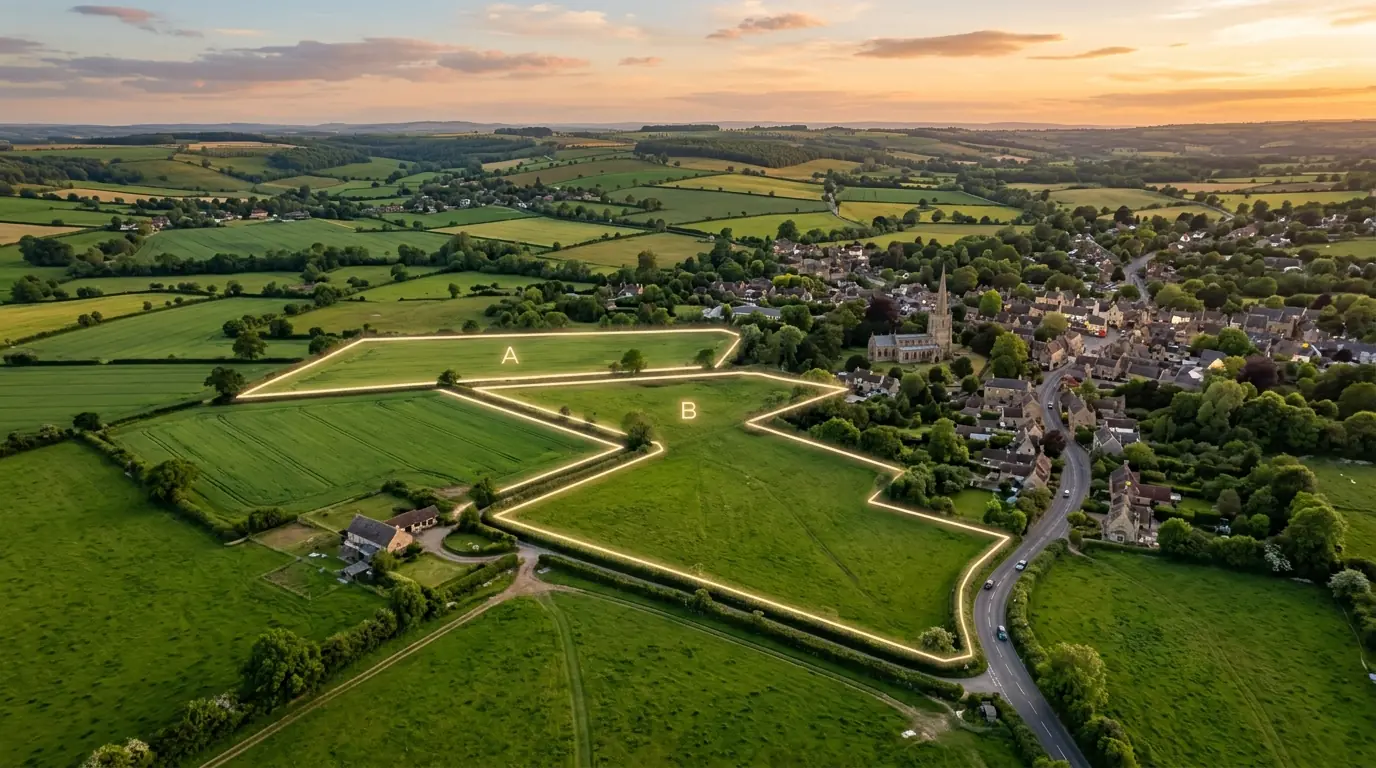
Selling land with development potential across England
We Buy Land With Hidden Potential. Unlocking Its Full Value, With Every Planning Cost Paid for You.
Whether you farm it, inherited it or own an old yard, we agree a price for your land at the start, set above what it is worth today. We then pay for and manage all of the planning work, at our own cost and risk. If permission is granted, you receive the agreed price on completion. If it is not, you keep your land and owe nothing.
- Price agreed up front. Set above what your land is worth today, before any planning work starts.
- Planning paid for. Surveys, design, council fees and appeals are paid for on your behalf.
- Nothing to lose. If planning is not achieved, you keep your land and owe nothing.
- Keep using your land. Carry on farming, grazing or letting it until completion.
Received a letter from us? Find out why we wrote to you.
Quick check
Could Your Land Take New Homes?
Enter the size of your land for a rough indication, then ask for a free review.
- Planning success rate
- 94.8%
- Planning approvals and local plan allocations
- Paid to landowners
- £340M+
- Land payments completed across the UK
- Planning costs paid by us
- 100%
- Surveys, highways, ecology, legal and appeal costs
- Homes consented
- 14,500+
- Across growth areas in England
- Cost to the landowner if planning fails
- £0
- You keep your land and owe nothing
How it works
Three Steps, and You Never Pay for Planning
Most landowners we speak to have never sold land before and have no wish to become planning experts. The process is designed so that you do not have to.
A Free Desktop Review
We look at the planning position, road access, flood risk, heritage and the council's housing need, then tell you honestly whether your land is worth pursuing. If it is not, we say so and explain why.
A Price Agreed Up Front
If the site looks promising, we agree a price with you under an option agreement, set above what the land is worth today. Your own solicitor and land agent check every term, and we contribute to their fees.
We Do the Planning, You Get Paid
We pay for and run all of the planning work, with our own planners, consultants and funding. If permission is granted, we complete the purchase and you receive the agreed price.
If planning is not achieved within the option period, the agreement ends, you keep your land and you owe nothing. You carry on farming, grazing or letting the land throughout. See every stage in detail, including what you would sign.
Who we help
Landowners in Very Different Situations
There is no typical seller. These are the people who most often get in touch, and what tends to matter to each of them.
Farming Families
You want to know whether a field on the edge of the village could fund a retirement or help the next generation, without giving up the rest of the farm or stopping work on the land while planning is pursued.
Selling farmlandPeople Who Have Inherited Land
You may own a paddock or a field with brothers and sisters, often a long way from where you live. You want a straight answer about what it is worth and a process the whole family can agree to.
Selling inherited landOwners of Paddocks and Small Fields
Small sites of a few acres can suit a modest village scheme, and national policy now expects councils to find more land on small sites. Access is usually the deciding factor.
Selling a paddockOwners of Old Yards
Former commercial yards and depots can be the easiest land to get planning permission for, because national policy favours reusing land that has already been developed.
Selling a brownfield site
We also work with executors, trustees and family companies, and with the land agents, solicitors and accountants who advise them. Land agents can introduce a site here.
Land value
Why Planning Permission Changes What Land Is Worth
Land is valued for what it can be used for. Planning permission for new homes is the single biggest change that can happen to that value.
1. Existing use value
What the land is worth as farmland, grazing or an old yard, with no prospect of planning.
2. Hope value
What some buyers pay because planning might be possible one day.
3. Price agreed with you
Set above today's value, fixed before any planning work starts.
4. Value with planning permission
What a housebuilder can pay once permission is granted, after their costs and profit.
A field valued as farmland is priced on what it can earn from farming. The same field with planning permission for housing is valued on what a housebuilder can pay after allowing for the cost of building the homes, the roads and drainage, affordable housing, contributions to schools and infrastructure, Biodiversity Net Gain, and their own profit. The difference between the two is the uplift that planning creates.
The catch is that getting that permission costs a great deal before any decision is made, and there is no guarantee of success. That is the part we take on. On a larger site, the surveys, design, applications and any appeal can cost as much as £300,000, and we pay all of it. We agree your price before the work starts, so you know the figure in advance and do not risk a penny of your own money getting there. Read how land value is worked out.
Is your land suitable?
What Makes Land a Good Prospect
You do not need to know the planning rules to ask us to look. These are the things we check first.
- It sits next to, or is well related to, an existing town or village.
- It has road frontage, or a realistic way of getting safe access to a road.
- Most of it is outside the highest flood risk zone.
- It is not covered by a strong protection such as a Site of Special Scientific Interest.
- The local council needs more housing land, or is preparing a new local plan.
- Every owner is willing to consider it, even if not everyone has decided yet.
Land inside the Green Belt is not automatically ruled out. Since December 2024 some of it can count as grey belt, where housing can be approved if the tests are met. Our grey belt guide explains how that works.
We would rather tell you early if your land is not suitable. Sites deep in open countryside, land that cannot reach a road, and fields mostly in flood zone 3 rarely get planning permission, and it would not be fair to tie you into an agreement that cannot succeed.
Why landowners choose us
A Straightforward Agreement, With Your Interests Protected
You Know the Price First
We agree the purchase price in writing at the start, set above today's value. No fees or costs are taken off it later.
No Planning Costs, Ever
Surveys, design, council fees, local plan representations and appeals are all paid for on your behalf, whether or not planning succeeds.
Your Own Advisers, Paid For
You should never sign without independent advice. We contribute to the cost of your own solicitor and land agent.
Complete Confidentiality
We do not contact the council, your neighbours or anyone else about your land without your agreement.
We are proud joint venture partners of BuildUp, which means every agreement we sign has experienced planners, architects, consultants and funding behind it from day one. See how our approach compares with promotion agreements and other routes.
Where we work
Land Across England
We review land anywhere in England. These are the counties where we are most active, each with a page showing how its councils are performing on housing delivery and where their local plans stand.
Across England, 93 of the 301 councils measured scored below 75% in the government's latest Housing Delivery Test, published in August 2026. Under the new national planning rules, that result counts as evidence of unmet housing need, which is one of the routes to getting homes approved on the edge of a settlement. See the full picture by area.
Track record
Example Schemes
How land moves from a field to a planning permission, and what had to be resolved along the way.
The Orchard Estate, Stratford-Upon-Avon
28 acres in Warwickshire, 245 homes, 19 months to consent. Family achieved an agreed return well above agricultural baseline, with £0 spent on technical consultants and zero planning risk.
Read the exampleGrange Park Expansion, Northamptonshire
44 acres in Northamptonshire, 390 homes, 24 months (local plan allocation). All three landowners received substantial, pre-agreed payments far exceeding their baseline unconsented land values, while continuing to graze livestock throughout the process.
Read the exampleWindmill View, Oxfordshire Borders
18 acres in Oxfordshire, 140 homes, 16 months to consent. Owner transformed an inherited, non-income-producing parcel into life-changing capital at zero personal expense.
Read the example
From our founder
Why We Set Up Subhan Property Group
Most landowners I meet are not looking to become developers. They want to know whether their land could be worth more, what it would involve, and whether they can trust the people asking. I set up Subhan Property Group to give them straight answers, a price they know in advance, and planning costs they never have to pay.
Every conversation starts with a free review and an honest view, including when the honest view is that your land is unlikely to get planning. Meet the team.
Guides
Plain-English Guides for Landowners
Written to answer the questions landowners actually ask, checked against current planning and tax rules, and updated when they change.
Land Agreements · 10 min read
Option Agreements Explained: What Landowners Sign and Why
How a land option agreement works, the terms that matter (fee, period, price, deductions, obligations), and what to ask your solicitor before you sign.
Tariq Subhan · Updated 23 September 2026
Planning Policy · 12 min read
The New NPPF (August 2026): What It Means for Landowners
The National Planning Policy Framework was rewritten in August 2026. What changed, the new rules for land outside settlements, and what it means for your land.
Julian Henderson MRICS · Updated 23 September 2026
Planning Policy · 13 min read
Grey Belt Land Explained: Could Your Green Belt Field Be Developed?
What grey belt is after the August 2026 NPPF, which Green Belt purposes count, the tests for housing, the Golden Rules, and what it all means for land value.
Ali Aziz Tarar · Updated 23 September 2026
Browse all guides or look up a term in the land and planning glossary.
Questions landowners ask
Frequently Asked Questions
How does selling land to Subhan Property Group work?
We agree a purchase price with you under an option agreement, set above what your land is worth today in its current use. We then fund and manage all of the planning work, at our own cost and risk. If planning permission is granted, we complete the purchase and you receive the agreed price. If planning is not achieved, you keep your land and owe nothing.
Is this an option agreement or a promotion agreement?
It is an option agreement with a fixed price, agreed with you in writing before any planning work starts. Under a promotion agreement, by contrast, what you receive is a share of whatever the land eventually sells for, after the promoter's costs and fee have been deducted. With us, nothing is deducted from the agreed price. Our option vs promotion page compares the two side by side.
How is the price for my land decided?
We carry out a desktop review of the title, access, constraints, the local housing need and the council's plan position, and estimate how many homes the site could realistically take. From that we propose a price above the land's current-use value. Your own land agent can then review it and negotiate on your behalf.
Who pays for the planning, surveys and application fees?
We pay for all of it: highways, drainage, ecology and Biodiversity Net Gain, heritage and landscape studies, design, council fees and, if needed, appeals. On a larger site that can reach £300,000. You never pay towards the planning work, and none of it is deducted from your price.
What happens if planning permission is refused?
We may appeal or try again within the option period if there is a realistic prospect of success. If planning is not achieved by the end of the option period, the agreement ends, you keep your land and you owe us nothing.
When do I receive the money?
Any option fee is paid when the agreement is signed. The agreed purchase price is paid to you on completion, once planning permission has been secured. Your agreement sets out each milestone, and we keep you informed at every stage so you and your accountant can plan ahead.
Can I keep farming or using the land during the planning process?
Yes. You keep owning and using the land, whether that is farming, grazing, letting or anything else, right up to completion. Surveyors will occasionally need access, always arranged with you in advance.
What kind of land do you buy?
Farmland, paddocks, inherited land, old yards and other previously developed land, usually from about 2 acres upwards, that sits next to or close to a town or village and could have safe road access.
Which areas do you cover?
We work across England, with most activity in the South East, East of England, the Midlands, the South West and the North West, where the need for housing land is greatest.
Do you pay for my own solicitor and land agent?
Yes. We contribute to the reasonable cost of your own independent solicitor and land agent, so that someone acting only for you reviews and approves every term before you sign.
Will you contact the council or my neighbours without telling me?
No. Our initial review is a desktop exercise using publicly available information. We will not contact the council, neighbours or anyone else about your land without your agreement.
Do you pay introduction fees to land agents and surveyors?
Yes. We welcome introductions from land agents, surveyors and other professionals, respect existing client relationships and pay an introduction fee on a successful agreement. See our page for land agents for details.
Have a question about your own land?
Find Out What Your Land Could Be Worth
A free, confidential desktop review of your land. No cost and no obligation.